
Why Buyers Source Bus Shelters from China
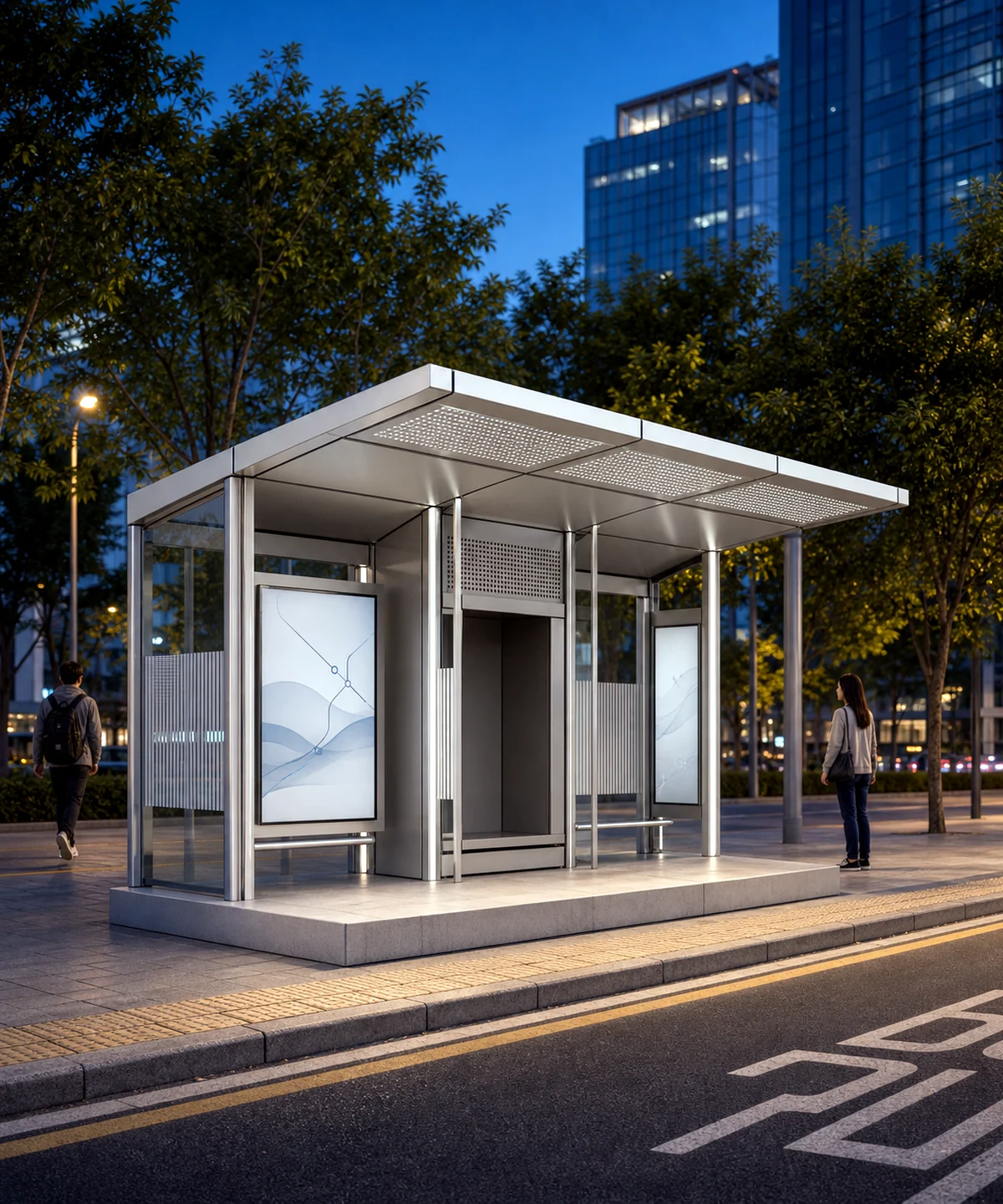
A modern bus shelter is not a simple canopy. It combines a structural steel or aluminium frame, tempered safety glass, seating, drainage, night lighting, advertising light boxes and — increasingly — LED or LCD route displays. That makes it a metal fabrication project, a glazing project and an electrical project at the same time, and it is why buyers worldwide look to Chinese factories that keep the whole chain in-house.
Price matters, but integration matters more. A factory such as HuaSheng — a Guangzhou bus shelter manufacturer working in the trade since 1989 — runs laser cutting, CNC forming, robotic welding, an automatic coating line, clean assembly and container loading inside one 120,000 m² plant, so a shelter never leaves the supplier's quality system until it is packed. You can see how that production base is organised on our capabilities page.
The second reason is design freedom. Western catalogue shelters come in fixed models; Chinese manufacturers routinely build to a city's own drawings or an architect's renderings. HuaSheng's delivered work — from Beijing Olympic stainless steel shelters and Hong Kong MTR metalwork to export projects in Qatar, Saudi Arabia, Oman, Korea, Romania, New Zealand and Nepal — is collected on our projects page.
The trade-off is distance. You cannot drop by the factory every week, so a disciplined procurement process has to replace proximity. The five steps below are that process.
Step 1: Define Your Specification
Most sourcing delays trace back to an underspecified enquiry. Before you contact any supplier, settle the following points — even provisionally:
- Dimensions and bay layout. Overall length, depth and height, and whether stops are single-bay or multi-bay. City programmes often mix sizes: HuaSheng's Nansha programme, for instance, combines 9 m, 12 m, 15 m and 18 m shelter types across one network.
- Structure material. Hot-dip galvanized steel with outdoor powder coating is the workhorse for most urban environments. Stainless steel (such as 304) is the choice for coastal, high-humidity or high-corrosion sites. Aluminium profiles are lighter, naturally corrosion-resistant and friendly to modular knock-down shipping. Describe your environment — salt air, desert heat, heavy rain, freeze-thaw — and let the manufacturer recommend material and finish.
- Glazing and roofing. Tempered safety glass, polycarbonate or solid metal canopies, with drainage falls and shading designed for your climate.
- Roof loading and wind. State the design wind speed and any snow load from your local building code, and ask the supplier for structural calculations and anchoring details that your own engineer can review against local requirements.
- Power and lighting. Decide early whether shelters carry mains lighting only, backlit advertising light boxes, LED/LCD route displays, USB charging or Wi-Fi — electrical scope changes the frame design. If you are considering solar power, tell suppliers the required autonomy and your site's sun conditions so panels and batteries can be sized realistically.
- Mounting and foundations. Confirm whether columns bolt to cast foundations via baseplates or are embedded. Foundations are almost always built by a local contractor, so ask the supplier for foundation drawings and anchor bolt templates as part of the deliverables.
Step 2: Evaluate Suppliers
With a specification in hand, shortlist two or three manufacturers and test them on five fronts:
- References in comparable climates. A shelter proven in a mild climate says little about desert heat or coastal salt. Ask for delivered projects in conditions like yours. HuaSheng's export references span the Gulf (Doha, Riyadh, Dammam, Oman), Oceania (New Zealand), Asia (Korea, Nepal, Hong Kong) and Europe (Romania).
- Factory verification. Confirm you are dealing with a factory, not a trading company. Visit if you can; if not, request a live video walkthrough of the cutting, welding, coating and assembly workshops, or commission a third-party factory audit.
- IP and design ownership. If you supply the design, agree in writing who owns the drawings and tooling and whether the supplier may resell the model. A supplier with its own patent portfolio — HuaSheng holds bus shelter design patents and structural utility patents — is generally more careful about respecting yours.
- Quality control process. Ask how quality is gated: incoming material inspection, first-piece inspection, in-process patrol and final inspection should all exist as documented steps, under a certified system such as ISO 9001. Request sample inspection reports before you order, not after. HuaSheng's DMAIC-based quality system is documented on the quality page.
- Communication. Judge response speed, the quality of English drawings, and whether you get a single named project contact who will take a video call from the shop floor. This is the daily reality of remote procurement.
Step 3: Understand the Production Process
You do not need to be a metallurgist, but knowing the production sequence lets you place inspection points where they matter. A well-run shelter factory follows a flow like HuaSheng's standard process:
- Engineering review — drawings are translated into a manufacturable plan before any metal is cut.
- Incoming inspection (IQC) — steel, aluminium and accessories are checked before stocking.
- Cutting and forming — laser cutting, CNC punching, bending and tube forming.
- Welding — robotic welding for repeatable structural seams, skilled manual welding for visible joints.
- Surface treatment — the step that decides outdoor lifespan. HuaSheng runs a digital automatic spray line covering pre-treatment, electrophoresis, powder coating and baking. Whoever you buy from, ask for the coating system, film thickness specification and any corrosion test data.
- Assembly and commissioning — light boxes, displays and wiring are integrated and powered up in the factory, so electrical faults are found before the container ships.
- Final inspection (FQC) — appearance, structure and electrical checks against the agreed acceptance criteria.
- Packing and loading — protective packing and container loading planned for the destination.
Ask your supplier to send photo or video evidence at the gates you care about — typically first-piece approval, pre-coating, and final inspection — and consider a third-party pre-shipment inspection for a first order.
Step 4: Plan Logistics and Shipping
Bus shelters ship by sea container, and the packing decision drives cost:
- Knock-down vs pre-assembled. Flat-packed knock-down kits maximise container utilisation and cut freight per shelter, but shift assembly work to site. Shipping pre-assembled body units minimises site work but consumes container space. Many projects use a hybrid: column-and-light-box body units assembled in the factory, with canopy modules and glazing packed flat. HuaSheng packs shelters as modular units classified by assembly sequence and uses totem-style container loading to maximise utilisation.
- Loading plan. Before contract, ask for a container loading plan showing how many shelters fit per 40-foot container — this single document lets you compare freight economics between suppliers.
- Protection. Tempered glass and powder-coated surfaces need dedicated protective packing; confirm the packing specification in writing.
- Commercial terms. Agree the Incoterm (FOB, CIF or DAP), who clears customs, and check your own import duties and any local certification requirements before signing.
- Schedule. Production and ocean transit times vary with scope, route and season — confirm the combined production-plus-shipping schedule with your supplier and build a buffer ahead of any contractual installation deadline.
Step 5: Installation and After-Sales
For most export projects the manufacturer does not send an installation crew; your local contractor installs, and the factory supports them. That support package is what you should specify:
- Foundation drawings and anchor bolt templates issued early, so civil works run in parallel with production.
- Step-by-step assembly manuals matched to the packing sequence, plus wiring diagrams for the electrical scope.
- Remote support — drawings clarified and video calls answered while crews are on site. This is HuaSheng's standard model for overseas projects.
- Spare parts ordered with the main shipment: glass panels, lamps or LED modules, locks and fasteners are far cheaper to ship in the same container than to courier later.
- A written warranty that distinguishes structure, coating and electrical components, and names the after-sales contact who handles replacements.
The RFQ Checklist
Copy this list into your enquiry. A supplier who receives all of it can usually come back with a realistic quotation and plan in the first reply:
- Quantity and shelter types (with a size mix if the programme has one)
- Dimensions, drawings or renderings — even concept sketches help
- Destination country and preferred port
- Site environment: coastal, desert, heavy rain, snow, design wind speed
- Structure material preference (galvanized steel / stainless steel / aluminium) or "recommend"
- Glazing and roofing type
- Electrical scope: lighting, advertising light boxes, LED/LCD displays, USB, Wi-Fi, solar
- Mounting and foundation approach, and who builds the foundations
- Applicable local standards or codes the design must satisfy
- Certification and inspection requirements, including any third-party inspection
- Target delivery schedule and any contractual deadlines
- Installation arrangement and the support you expect from the factory
- Spare parts and warranty expectations
- If light boxes will carry paid advertising: the media operator's panel and access requirements
Frequently Asked Questions
Can bus shelters from China be customised to our city's design?
Yes. Established manufacturers build to your drawings, renderings or local transit standards rather than from a fixed catalogue. HuaSheng engineers single-bay to multi-bay shelters with custom lengths, canopy shapes, seating, light boxes and route displays — see the bus stop shelter hub for the specification options.
How are bus shelters shipped from China?
By sea container, usually as modular knock-down kits flat-packed and classified by assembly sequence, with glazing and coated surfaces protected for transit. Larger pre-assembled body units can be loaded when site work must be minimised. Always request a container loading plan.
Does the supplier install the shelters overseas?
Typically no — your local contractor installs, supported by the factory's foundation drawings, bolt templates, wiring diagrams, assembly manuals and remote guidance. Confirm the exact support scope in writing.
How can we verify quality without visiting the factory?
Ask for documented quality gates (IQC, first-piece, IPQC, FQC), photo and video reports at each stage, live video walkthroughs, and references in comparable climates — and appoint a third-party pre-shipment inspection if it is your first order. HuaSheng operates ISO 9001 quality management with a DMAIC control process.
What should an RFQ for bus shelters include?
Quantity and types, dimensions or drawings, destination, site environment, materials, glazing, electrical scope, foundations, applicable standards, inspection requirements, schedule, installation arrangement and warranty expectations — the full checklist is in the section above.
Which structure material is best for our climate?
Galvanized steel with powder coating for most urban sites; stainless steel for coastal and corrosive environments; aluminium where weight and knock-down shipping matter most. Describe your environment and ask the manufacturer to recommend the combination.
Start With One Conversation
Sourcing a bus shelter from China is a process problem, not a gamble — a clear specification, a verified factory, visible quality gates and a sensible logistics plan remove almost all of the risk. If you would like to test the process on a real enquiry, send your project outline (or just the RFQ checklist above, half-filled) to HuaSheng via the contact page, and the team will reply with a quotation and plan within one business day.